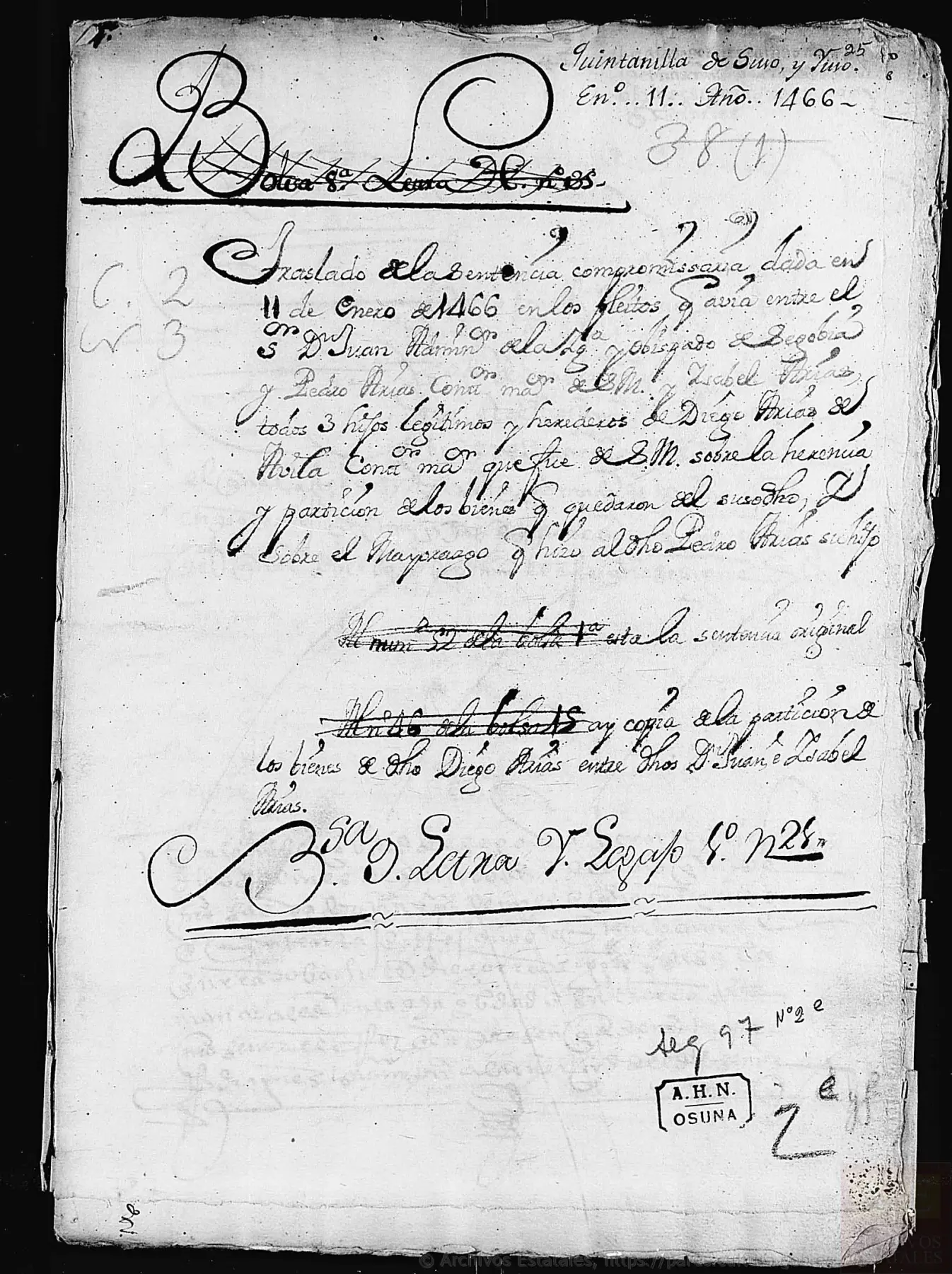
Hook. Pedro Arias Dávila — Pedrarias — governed Castilla del Oro, founded Panama City in 1519, and in that same year had Vasco Núñez de Balboa, his own son-in-law-to-be, judicially murdered. He is one of the few conquistadors whose Jewish descent is not folklore. And the reason it is not folklore is the whole point of this post.
The documentary chain
| Link | Evidence |
|---|---|
| Diego Arias Dávila, born Isaque Abenacar, Ávila c. 1400, baptised aged six or seven | Biographical tradition; he rises to contador mayor of Castile under Juan II and Enrique IV — the crown's chief financial officer |
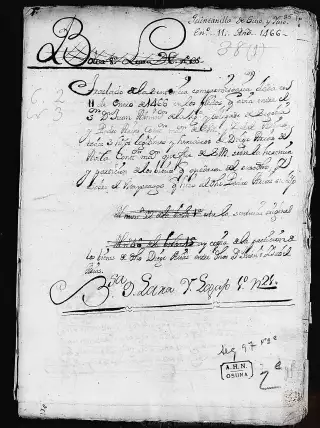
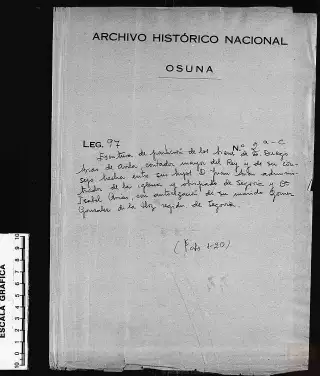
| Diego dies Segovia, 1 Jan 1466 | Estate partition, AHN Nobleza, OSUNA C.97 D.6-8 (in our register) |
| His son Pedro Arias "el Valiente" d. 1476 defending Madrid; marries María Ortiz de Cota | Cota is itself a well-known Toledan converso lineage — Pedrarias is converso on both sides |
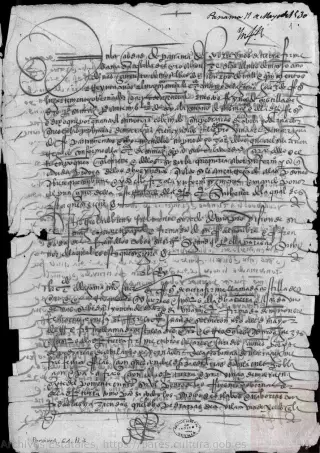
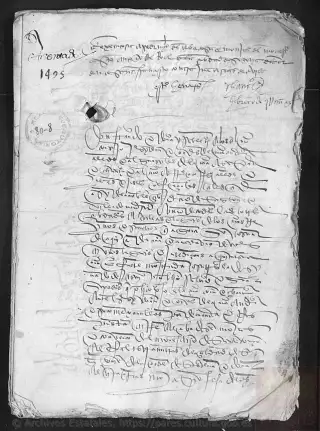
| Their son is Pedrarias, b. Segovia c. 1440, d. León Viejo, Nicaragua, 6 Mar 1531 | AGI PATRONATO 26 R.5 (451 images), PANAMA 61 N.7, CONTRATACION 3253 L.1 — all in our register |
We hold 18 archival records for this family across AHN Nobleza, AGS Registro General del Sello, Chancillería de Valladolid and the AGI.
Why the descent is documented at all
Because the family was prosecuted.
- 21 January 1486 — first denunciation, by Pedro Giraldo, a carder.
- 29 June 1489 — the Segovia tribunal formally charges Diego Arias Dávila, his wife Elvira González, and her mother Catalina González with Judaizing. All three are already dead. Diego had been in his grave twenty-three years.
- 1486–1492 — 231 testimonies taken in Segovia and Ávila.
- 7–8 July 1489 — their son Juan Arias Dávila, Bishop of Segovia, is notified and fights: jurisdictional challenge, appeal to the Catholic Monarchs, appeal to Innocent VIII in autumn 1489. The pope commissions auditor Giovanni Antonio Sangiorgio (22 Oct 1489) to inhibit the Segovia tribunal.
- March 1490 — the bishop leaves for Rome to press the case. In 1490 the Monarchs reverse their support, calling the evidence grave. He never returns; he dies in Rome in 1497.
Edition of the trial: Carlos Carrete Parrondo, Fontes Iudaeorum Regni Castellae III: Proceso inquisitorial contra los Arias Dávila segovianos: un enfrentamiento social entre judíos y conversos (Salamanca, 1986). Three unpublished 1490 documents: Archivo de la Catedral de Segovia, F-156.
The takeaway
A converso family enters the historical record at the moment it fails to disappear. Diego Arias Dávila converted as a small child and became the richest official in Castile. That is what got his corpse put on trial. Obscurity was safety; prominence was exposure.
So the roster of "documented converso families" — Arias Dávila, Carvajal, Santa María/Cartagena, Santángel — is not a sample of converso Spain. It is a sample of converso Spain's most conspicuous failures to blend in. The ones who managed it left no trial record, because there was no trial.
Two consequences, and readers need both:
- The absence of a converso document for your family is not evidence of absence. It is the expected outcome for a family that succeeded. Most conversos are invisible by design — theirs and their descendants'.
- That is not permission to assume. An open question is not a yes. What closes it is a named person in a dated record, not a surname on a list.
One absence that says it all
"Abenacar" appears exactly once in the whole of PARES — a 1493 record for one Ça Abenazar of Villa de don Juan, with no connection to this family whatsoever. The Jewish name vanishes from the archive at the moment of baptism. The surname that replaces it, Arias Dávila, is indistinguishable from any Old Christian one.
That single absence teaches the site's rule better than any argument: the citation carries the claim, never the marker.
Sources
- Carrete Parrondo, Proceso inquisitorial contra los Arias Dávila segovianos (Salamanca, 1986)
- "El obispo segoviano Juan Arias Dávila y la Inquisición: una revisión del conflicto y tres documentos inéditos de 1490", Anthologica Annua
- AHN Nobleza OSUNA C.97; AGS RGS; ARCHV Registro de Ejecutorias; AGI PATRONATO 26, PANAMA 61, CONTRATACION 3253