The entries
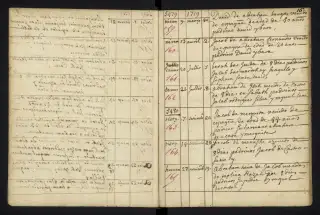
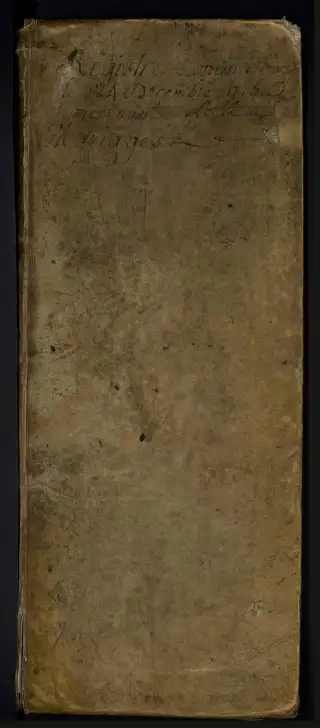
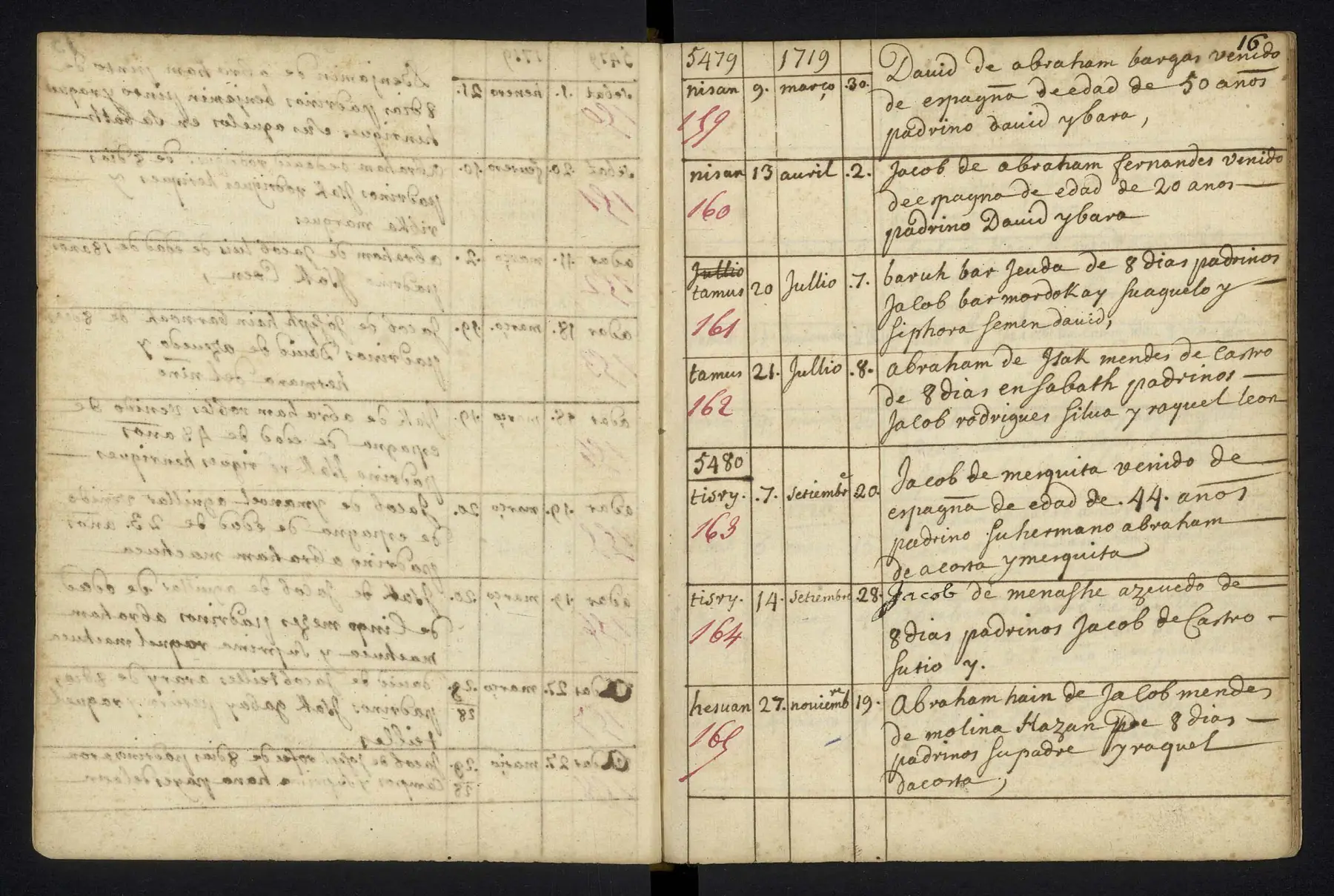
GG 842, f.16 — Archives Bordeaux Métropole, Israélites Portugais, registre des circoncisions. Verbatim, spelling as written:
159 · nisan 9 / março 30, 5479 / 1719 "David de abraham bargas venido de españa de edad de 50 años, padrino david ybara"
163 · tisry 7 / setiembre 20, 5480 / 1719 "Jacob de mesquita venido de españa de edad de 44 años, padrino su hermano abraham de acosta y mesquita"
Around them on the same page are the ordinary entries — de 8 dias, eight days old, the infants. These two are not that.
Read entry 163 again. His godfather is his own brother, already in Bordeaux, already living as Abraham. One brother had made the crossing earlier and stood beside the other when his turn came. That is not an escape; it is a family doing this in sequence.
What was actually required
For a man of fifty in 1719 this was not a formality.
- Circumcision as an adult, without anaesthesia, with real risk of infection and death. He consented to it.
- A name. "David de Abraham Bargas" is a patronymic in the Jewish form — David son of Abraham. Whatever he had been called in Spain is not in this book. The register records the new man, not the old one.
- A language and a liturgy he may have known only in fragments, transmitted in secret across generations, or not at all.
- A sponsor. Somebody vouched. David Ybara stands godfather to both men in entries 159 and 160 — he is doing this repeatedly, which suggests a role, not a coincidence.
And the legal setting is the sharpest part
In 1719 these men were not legally allowed to be Jews.
The Bordeaux "Portuguese" were still, in French law, marchands portugais, autrement nouveaux chrétiens — New Christians, which is to say Catholics. Their status rested on Henri II's lettres patentes of August 1550, explicitly revocable on a year's notice, renewed almost annually.
Legal recognition came only in 1723, after the Nation paid 110,000 livres, when new lettres patentes named them for the first time as "Juifs… connus et établis en notre royaume sous les titres de Portugais, autrement Nouveaux Chrétiens." Two hundred and thirty years after the expulsions, France put the word Jew on them in writing. Bordeaux's first Jewish cemetery followed around 1724.
So GG 842, opened in 1706, is a register of circumcisions kept by people who were on paper Catholics, in a kingdom where that mattered, four years before the law caught up. Catholic baptisms and church marriages had quietly stopped in the early 1700s; the authorities had decided not to look. Choquette's observation that Marranos in the colonies "passed unremarked" while Protestants were hunted is the same phenomenon: Judaism was the cheaper secret.
The register is the community writing itself down before it was permitted to exist.
The long tradition these two men join
Solomon Molcho — born Diogo Pires, Portugal, c. 1500, a New Christian who rose to be secretary to the High Court of Appeals. After meeting David Reubeni in 1525 he circumcised himself. He preached, won an audience with Pope Clement VII, and in 1532 went with Reubeni to Regensburg to propose a joint Jewish-Christian army to Charles V. He was arrested, tried by an ecclesiastical court at Mantua, and burned in November or December 1532 — having refused a pardon that was offered on condition he return to the Church. As a baptised Christian, his Judaism was not apostasy in his own eyes; in the Church's, it was. That is the maximum price.
Menasseh ben Israel — born Manoel Dias Soeiro in 1604, a year after his parents fled Portugal and the Inquisition (birthplace given variously as La Rochelle, Lisbon or Madeira — unsettled, say so). Raised in Amsterdam, he became a rabbi, founded the first Hebrew press in Holland, wrote El Conciliador (1632) and The Hope of Israel (1650), and went to London in November 1655 to argue for the readmission of the Jews to England. At the Whitehall Conference that December the judges found no law forbidding their return. He died at Middelburg in 1657. A converso's son negotiated the end of a 365-year expulsion.
Between Molcho's pyre and Menasseh's audience with Cromwell lies the same act our two men performed quietly in a Bordeaux register: going back.
And today
For bnei anusim today the paperwork is harder than it was in 1719.
- Spain. Law 12/2015 opened citizenship to Sephardic descendants; the window closed in October 2019 (with an extension only for applications already filed).
- Portugal. The Sephardic route, created 2013 and formalised by Decree-Law 30-A/2015, was tightened in 2024 to require three years' legal residence, and closed on 19 May 2026 by Lei Orgânica n.º 1/2026. The Jewish Community of Lisbon stopped accepting submissions on 4 May 2026; applications already filed continue under the old rules.
- Religious return. Where a family's maternal line ran through Catholic baptism for four or five centuries — which is the normal case — halakhic continuity is broken, so what the rabbinate requires is not return but formal conversion, giyur. Practice varies by community and by rabbi; Israel's Law of Return does not treat documented converso descent as qualifying on its own.
In 1719 a man could arrive from Spain, be circumcised, have his brother stand beside him, and be written into the book as David son of Abraham. No proof of descent was demanded of him. Today the descent must be proved, and the civil doors that asked for that proof have both shut.
That is not a grievance. It is simply how things stand, and it is better to hear it plainly here than from someone selling surname certificates.
Sources
- Archives Bordeaux Métropole, BORDEAUX GG 842, f.16, images 020 (entries 159–165)
- Lettres patentes of August 1550 (Henri II) and 1723 (Louis XV)
- Wikipedia (fr), Histoire des Juifs dits portugais en France
- Solomon Molcho; Menasseh ben Israel
- Spain Law 12/2015; Portugal Decree-Law 30-A/2015 and Lei Orgânica 1/2026